It is widely known that fluoropolymers, represented by polytetrafluoroethylene (PTFE), possess properties such as stain resistance, non-stick behavior, acid resistance, heat resistance, and low friction, making them extremely useful in industrial applications. However, due to their high crystallinity, these resins cannot form transparent films. In addition, film formation requires high temperatures, which prevents their use in anti-fouling applications that require transparency.
In recent years, taking advantage of the properties of fluoropolymers, various coating agents capable of forming transparent films at room temperature have been developed and put into practical use. Here, we introduce a fluorine-based coating agent that can be applied to a variety of materials to provide anti-fouling properties and reduce fingerprint adhesion.
A reactive anti-fouling coating agent containing a PFPE base reacts with metal surfaces and adheres to them. This structure enables strong bonding with the metal surface, providing higher adhesion and forming a wear-resistant and anti-fouling surface after coating.
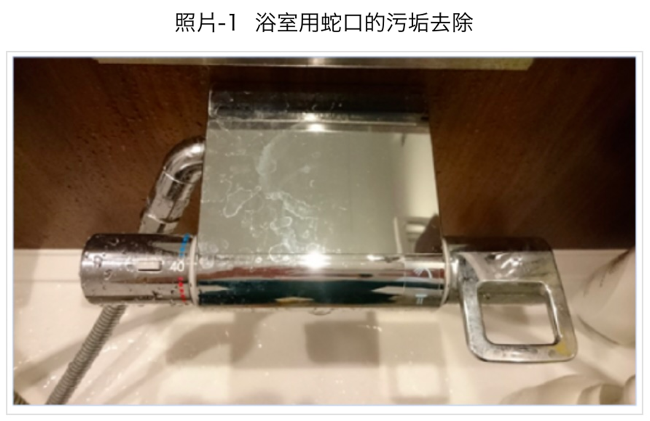
The thickness of this coating film is only 10–20 nm, making it invisible to the naked eye. As a result, it does not alter the appearance of the material while still providing anti-fouling performance. Photo 1 shows a bathroom faucet where the coating agent was applied to the right half. After one month of use, the dirt was wiped off with a cloth. Normally, water scale and detergent residue that cannot be removed simply by wiping can be easily removed from surfaces coated with this material.
This coating agent can also be applied to metal molds used for plastic molding as a releasing (demolding) layer. It not only reduces the surface tension of the mold surface but also exhibits a dynamic friction coefficient of 0.09 or lower, enabling consistently good release performance. Furthermore, because the coating thickness is only 10–20 nm, it faithfully reproduces fine structures ranging from the nanometer to micrometer scale on the mold surface, such as those used in nanoimprint processes. In addition, since the release-coating components do not adhere to the molded product, the product does not require cleaning after demolding, significantly improving production efficiency.